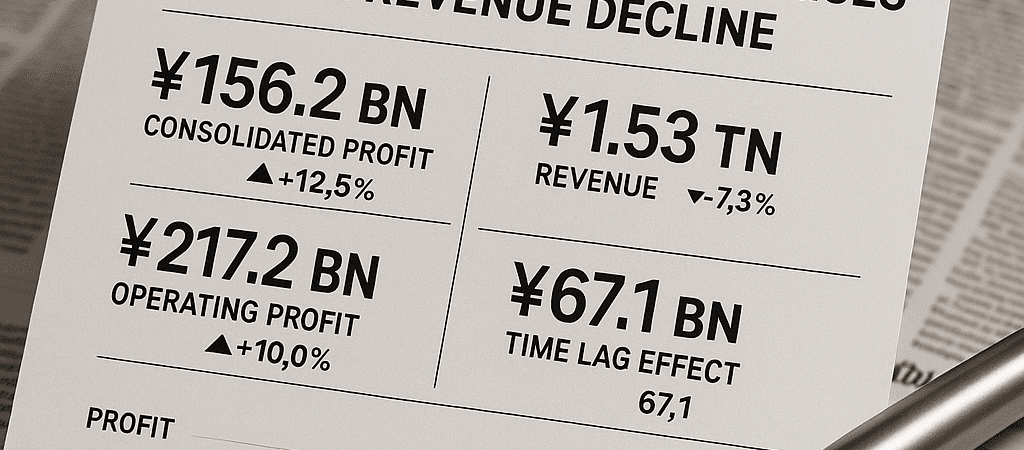
JERA Co., Inc., Japan’s largest power generation firm and a prominent player in the global LNG import market, announced a growth in second-quarter profits for fiscal 2025, even as total revenue decreased. This positive outcome was primarily attributed to stronger performance in its international and renewable energy sectors. For the six months ending September 30, 2025, JERA’s consolidated profit reached ¥156.2 billion, reflecting a 12.5% increase from ¥138.9 billion year-over-year. Operating profit also saw a 10% rise to ¥217.2 billion, while overall revenue fell by 7.3% to ¥1.53 trillion, largely influenced by reduced electricity sales prices. The profit increase was bolstered by a significant rise in the time lag effect—a pricing adjustment mechanism that mitigates fluctuations in fuel costs relative to electricity pricing—climbing from ¥16.6 billion to ¥67.1 billion. However, profit excluding the time lag experienced a 27% decline to ¥89.1 billion, attributed to weakening margins in the fuel business alongside higher procurement costs. JERA noted that the revenue drop was due to diminished income unit prices in electrical energy sales, while the decline in profit, excluding the time lag, was primarily a result of increased fuel procurement and inventory expenses. The fuel business accounted for ¥203.1 billion in revenue and ¥62.7 billion in profit, slightly down from last year’s ¥64.7 billion. Conversely, robust performance in the overseas power generation and renewable energy segment resulted in a profit surge to ¥19.9 billion, up from ¥4.2 billion a year prior, facilitated by successful independent power producer operations abroad. Profits from domestic thermal power generation and gas operations, however, saw a notable drop of ¥30.7 billion, impacted by LNG market competitiveness and shifts in inventory valuation. Total assets decreased to ¥7.98 trillion, down 7% from the conclusion of FY2024, largely due to asset transfers to JERA Nex bp, its joint venture with bp focused on decarbonization efforts. Liabilities were reduced by 10.7% to ¥4.99 trillion, while equity remained steady at ¥2.98 trillion. Operating cash flow surged to ¥324.7 billion, nearly doubling from the previous year, buoyed by lower fuel costs and increased earnings from equity-method affiliates. Free cash flow reached ¥258.5 billion, with the company disbursing ¥43.1 billion in dividends during the quarter. JERA upheld its full-year forecast, aiming for a total profit of ¥230 billion, consistent with its July outlook, expecting ¥200 billion in profit excluding time lag and ¥30 billion stemming from those effects. By segment, the fuel business is anticipated to contribute ¥120 billion, overseas renewables ¥30 billion, and domestic thermal and gas operations ¥80 billion. However, management cautioned that results could be impacted by fluctuations in global fuel markets and currency changes. The forecast is predicated on an assumption of crude oil prices around $72 per barrel (JCC) and an exchange rate near ¥146 per USD. JERA’s diverse quarterly performance reflects the significant challenges that global utilities face in volatile fuel markets while transitioning to sustainable energy sources. Japan’s energy landscape post-Fukushima heavily depends on imported LNG, making its utilities vulnerable to international price and currency shifts. Nevertheless, JERA is committed to expanding its international and renewable energy initiatives, aligning with Japan’s decarbonization goals and its ambition to reach net-zero carbon emissions by 2050. Its partnership with bp, announced in 2024, aims to spur low-carbon initiatives including hydrogen, ammonia, and carbon capture projects. Demonstrating its fiscal resilience, JERA earned an upgrade to AA– from Japanese rating agencies R&I and JCR in October 2024, while maintaining an A– rating from S&P Global.