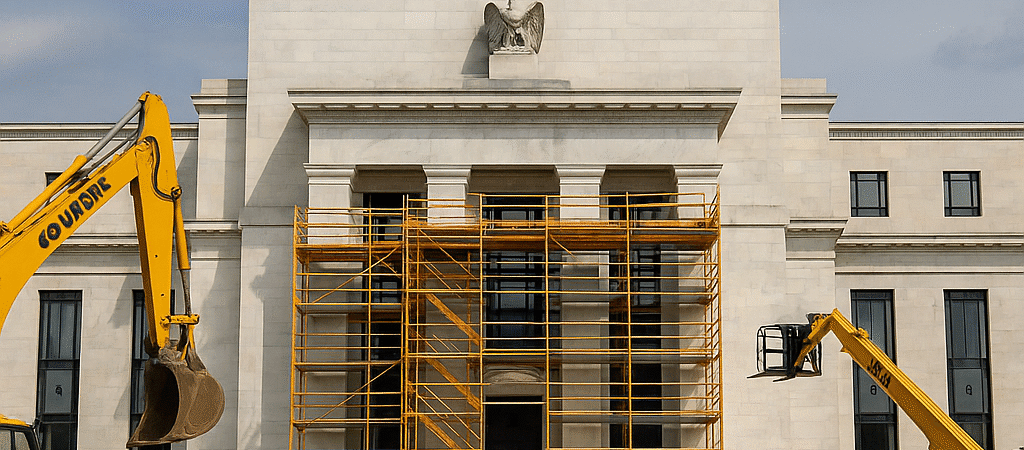
As construction progresses on the Federal Reserve Board Building, the Federal Open Market Committee convened on interest rate policy in Washington, D.C. on September 17, 2025. A recent Federal Reserve survey, unveiled on November 7, highlights policy uncertainty, particularly regarding global trade and central bank independence, as leading concerns for financial stability. The biannual Financial Stability Report indicates a decrease in apprehension over trade, while fears surrounding artificial intelligence have increased. In the previous April survey, global trade was the primary worry, but by late October, it has shifted to a broader view of policy uncertainty, which now encompasses trade, central bank independence, and the availability of economic data—issues cited by 61% of respondents. This marks the first time central bank independence has been recognized as a risk, influenced by President Trump’s dismissal of Fed Governor Lisa Cook and ongoing critiques of Fed Chair Jerome Powell’s interest rate policies. The lack of economic data availability has also been highlighted, coinciding with an unprecedented federal government shutdown that has obstructed official economic statistics. Moreover, 30% of the Federal Reserve’s market contacts cited artificial intelligence as a potential instability factor in the upcoming 12 to 18 months, mainly focusing on how changing perceptions of AI could trigger significant market losses and broader economic ramifications. Other notable concerns included persistent inflation, elevated long-term interest rates, and the sustainability of fiscal debt. In the commercial real estate sector, signs of stabilization were reported, as it recovers from volatility linked to earlier tariff announcements by Trump, despite a looming volume of maturing commercial real estate debt that could induce market volatility if forced sales occur. Although historically high consumer delinquency rates were noted, particularly in student loans, banks and broker-dealers are well-capitalized. However, notable leverage levels in other sectors, especially among hedge funds—reaching peaks not seen since 2013—raise caution. The Fed also expressed reservations about the private credit market, which remains opaque and could result in unforeseen losses, though recent high-profile bankruptcies in the sector appear to be isolated incidents.