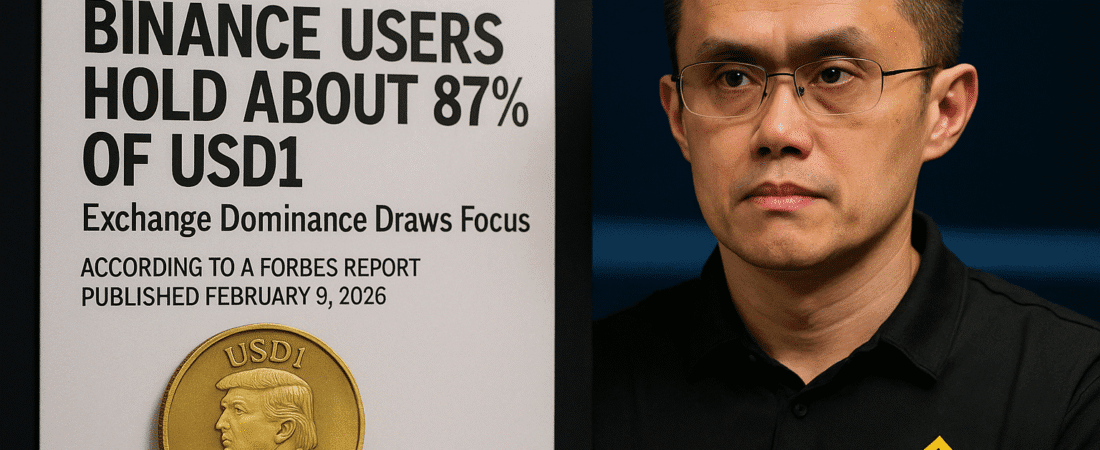
According to a Forbes report dated February 9, 2026, Binance users hold approximately 87% of USD1, the stablecoin associated with Donald Trump, leading to a concentration of most of its circulating supply on a single exchange. This has attracted criticism, but Binance founder Changpeng ‚CZ‘ Zhao attributes the numbers to legitimate user demand for stablecoins rather than any political bias. The report highlights that Binance controls nearly $4.7 billion of the total $5.4 billion USD1 supply, a higher proportion than any other exchange holds of similar top-10 stablecoins. This figure encompasses both wallets owned by Binance and customer balances, although it’s unclear what percentage belongs to the exchange itself. Launched in March 2025 by World Liberty Financial, a crypto venture associated with members of the Trump family, the USD1 token had CZ as one of its earliest promoters. Trump’s involvement is significant, as he is registered as a co-founder emeritus, with affiliations tied to him set to benefit from the earnings of the project’s governance token, WLFI. The concentration of custody has raised concerns from independent researcher Molly White, who warned of potential risks should assets become mired in legal disputes. Corey Frayer, a former adviser to the SEC, questioned whether USD1 was truly meant to serve as a widespread stablecoin. Responding on social media, Zhao stated, ‚Binance users hold the largest proportion of most stablecoins (USDT, USDC, USD1, and others) compared to any other centralized exchanges—this isn’t new.‘ The token’s scrutiny coincides with ongoing investigations into Zhao and Binance, particularly after the former CEO was granted a presidential pardon in October 2025 following a guilty plea in 2023 over compliance failures linked to anti-money laundering regulations. His attorney later emphasized the regulatory nature of the case, dismissing claims of political favoritism. Amid these developments, CZ and Binance are facing what they describe as an orchestrated campaign of fear, uncertainty, and doubt (FUD), highlighted by Zhao’s revelation of a fake social media account impersonating him to spread misinformation. An AI analysis has also claimed a ‚deliberately organized‘ smear campaign against the exchange. Market trends indicate that Binance’s influence extends well beyond USD1, as a CryptoQuant report from January noted the exchange’s share of spot trading volume at 41% and 42% of Bitcoin perpetual futures volume among major exchanges in 2025. The report also noted that Binance holds 72% of the combined USDT and USDC reserves across leading platforms, reinforcing Zhao’s assertion that significant user holdings on Binance are consistent with industry norms.